Retailers
aaaaaaaa

Roberto Bielli – DOSO PLANT BALLING METHODE – Part Three

THIRD STEP – DRY START METHODE AND FILLING THE TANK

Products Used:
SCUDO, LINFA A & B, BACTERYA, NUTROBACT, BIO-ALGANEX, FLORIDO C7.

Plants Used:
– Alternanthera reineckii ‘Mini’
– Bucephalandra sp. ‘Red’
– Cryptocoryne parva
– Eleocharis sp.’Minima
– Leptodictyum riparium (stringy moss)
– Anubias barteri var. nana ‘Mini’
– Anubias barteri var. nana ‘Mini Mini’
– Vesicularia dubyana

Tank:
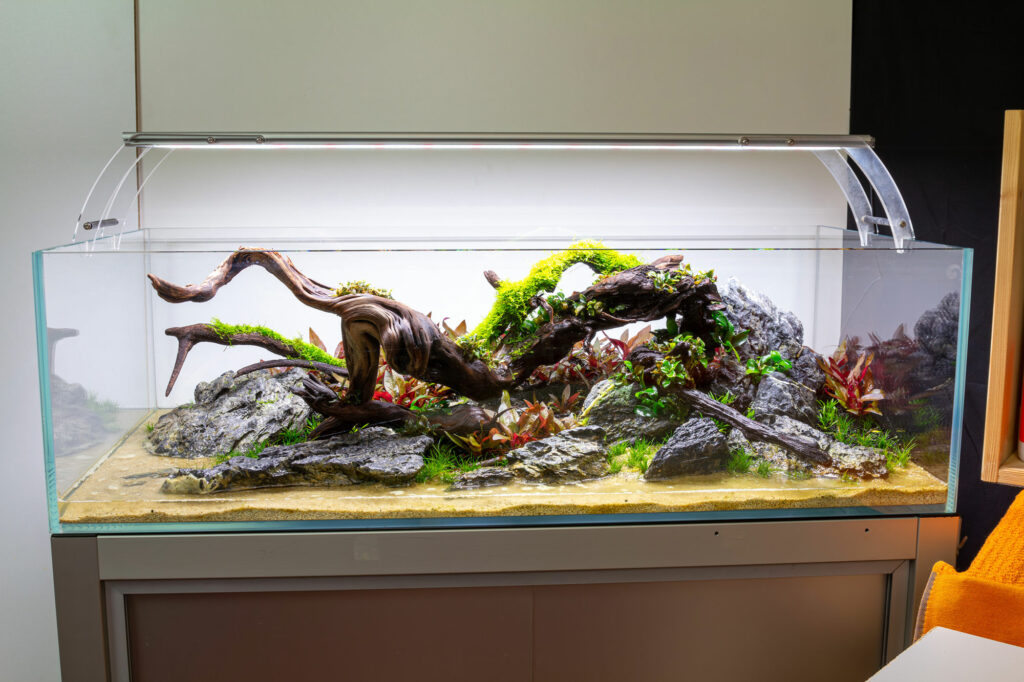
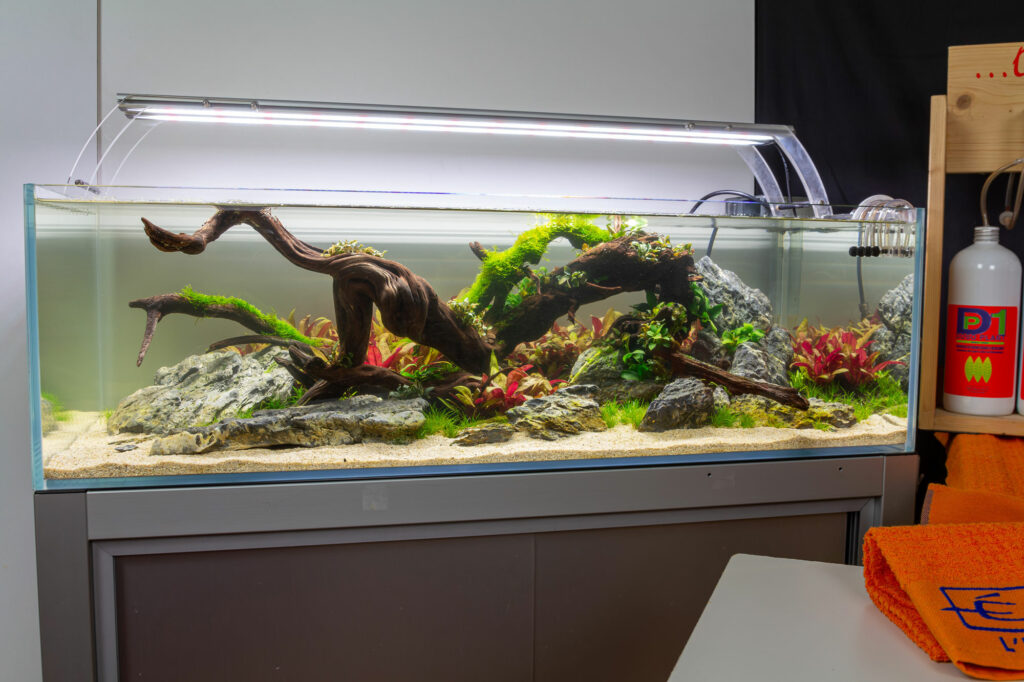
Shallow Tank 90x45x27 cm

Ceiling light:
GNC Heaven LED

Dry Start Methode ‘DSM’:
After the planting phase the tank began its maturation period, in particular I opted for the 30-day Dry Start Methode, let’s see together what this biosystem start-up procedure entails in detail:

– Nebulisation of the tank by means of an ultrasonic nebuliser inserted in the tank and operated by a timer to ensure a medium humidity level;
– Covering the tank with kitchen foil, suitably perforated to ensure constant internal humidity but also minimum air exchange, which is essential to avoid dangerous mould and fungal attacks;
– In this way we also allow the CO2 present in the atmosphere to be continually exchanged within the tank to ensure optimum photosynthetic activity of the plants;
– Maintain a constant water level (derived from reverse osmosis) in the substrate, replenished with Scudo, Linfa A & B and Bio Extra (bacterial floral activator and anti-algae) to promote biological activation of the biosystem;
– Constant 8-hour photoperiod from the first day of DSM;

The main advantages of activating a tank using the DSM procedure are as follows:
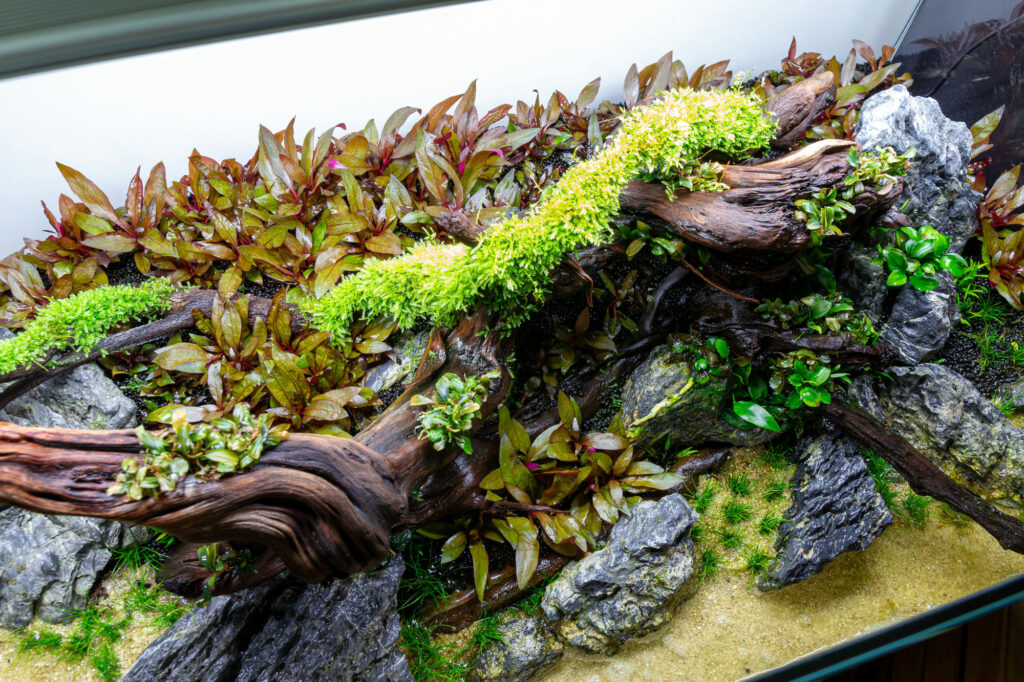
– Fast development and anchoring of mosses on wood and furniture;
– Faster plant rooting, as they do not have to change leaf morphology and do not suffer transplant stress;

During the DSM procedure, the tank must be constantly monitored, as the main risks are the occurrence of moulds and fungal attacks, which would compromise the balance of the biosystem and the success of the start phase.

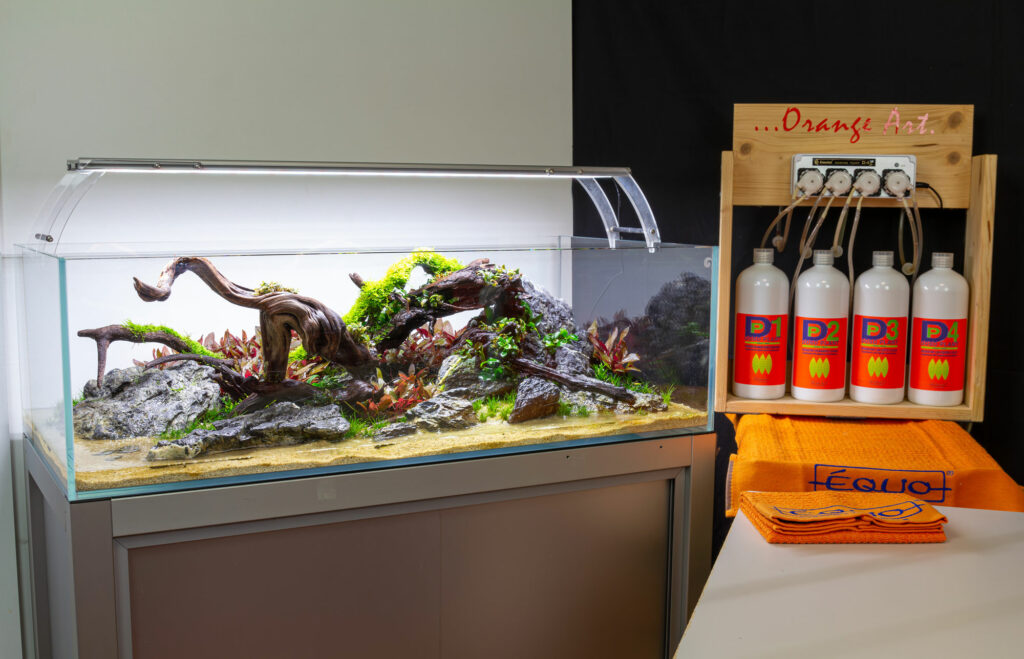
Below are photos of the Dry Start Methode, note the exponential growth of the plants driven by the rich substrate (VIGOR PLUS and Terra Nera) and the perfect anchorage of the mosses on the wood:
Filling the tank:

Net litres filled: 90lt water derived from reverse osmosis

Products inserted in Water and Dosage:

– LINFA A &B: to remineralise water to GH 8° dGH and KH 4° Dkh;
– SCUDO: 20 ml in 90 litres net;
– BACTERYA: 2 ampoules for tank activation;
– BIO-ALGANEX: 2 ampoules for tank activation;
– NUTROBACT: 1 vial of nutrient support for new bacteria;
– FLORIDO C7: Organic carbon supplementation, two dispenser pressures;
– Constant CO2 supply H24 from the moment the tank is filled;
– 8-hour photoperiod;
– Activation of the filter, filled with STILLA for the biological filtration part and simple perlon wool for mechanical filtration.

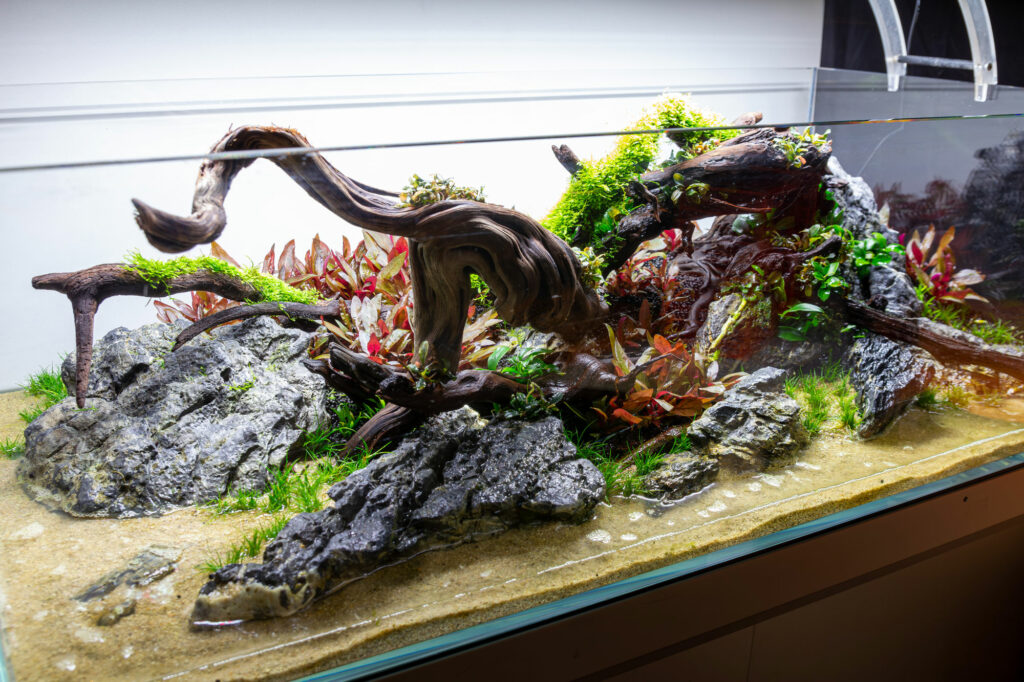
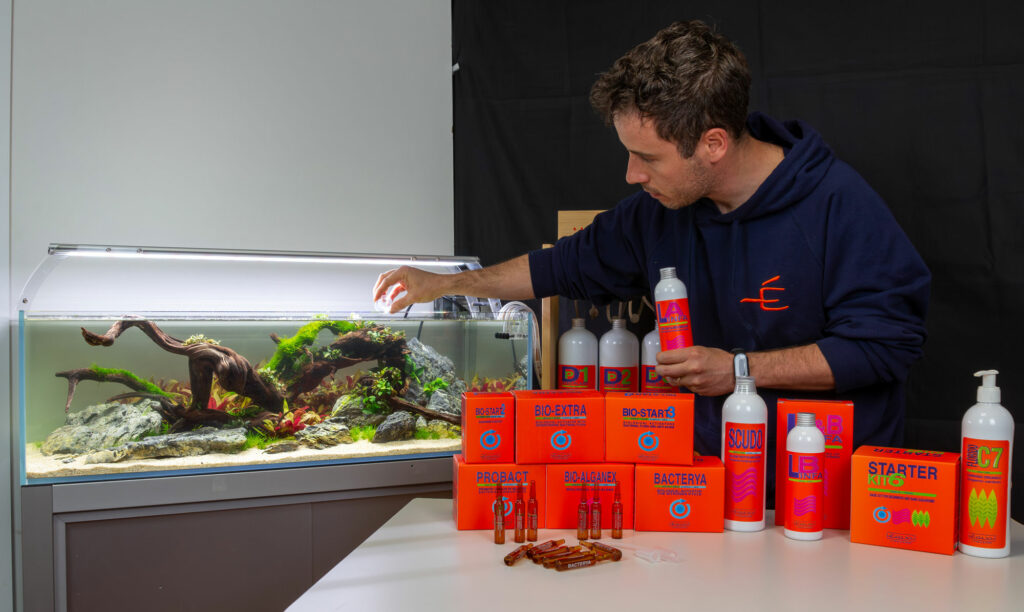
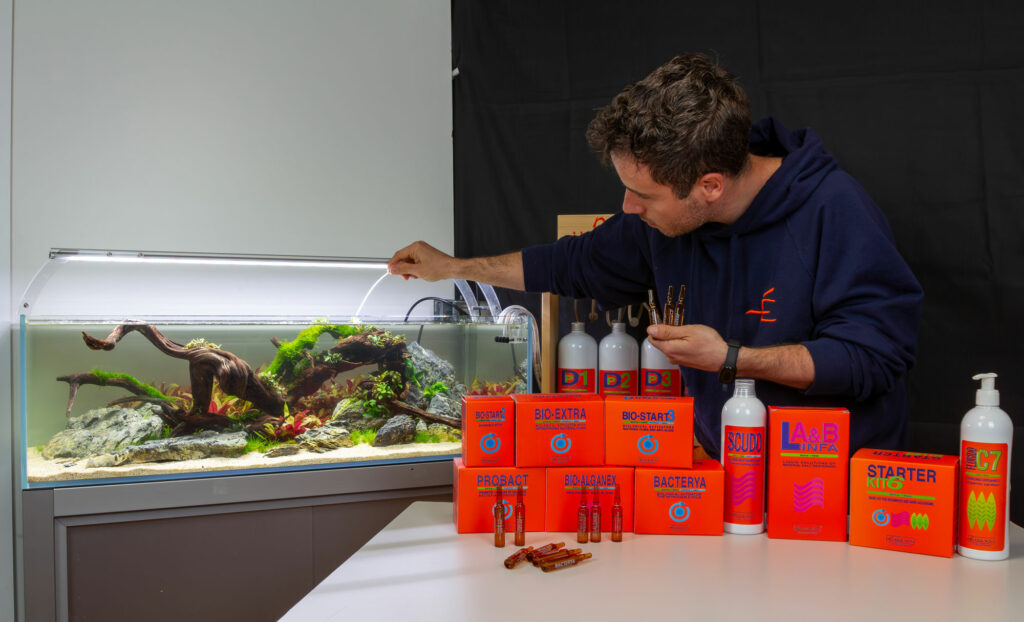
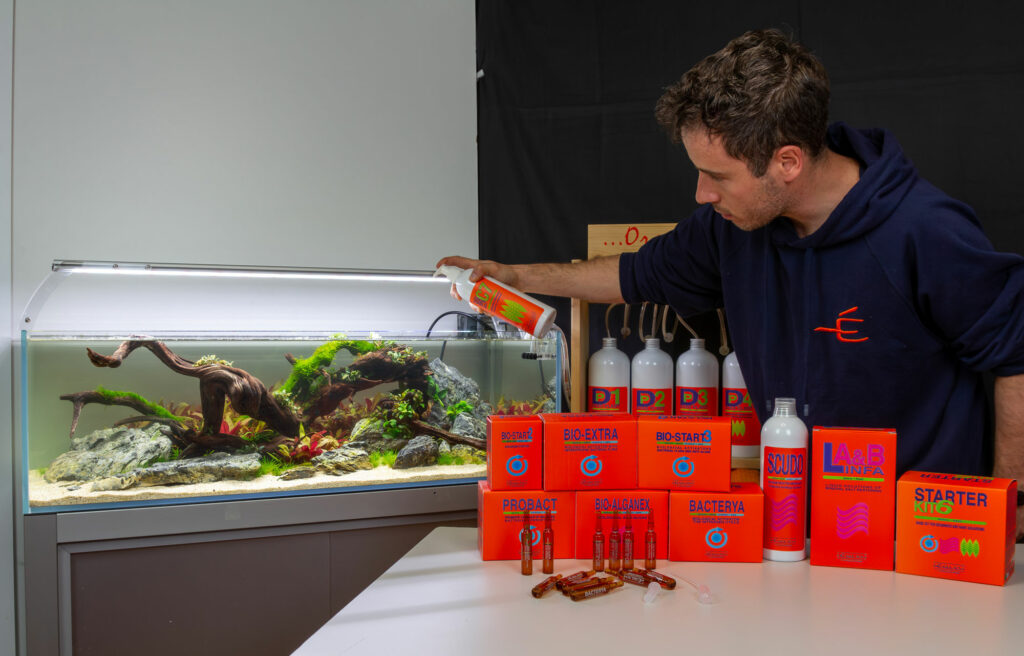
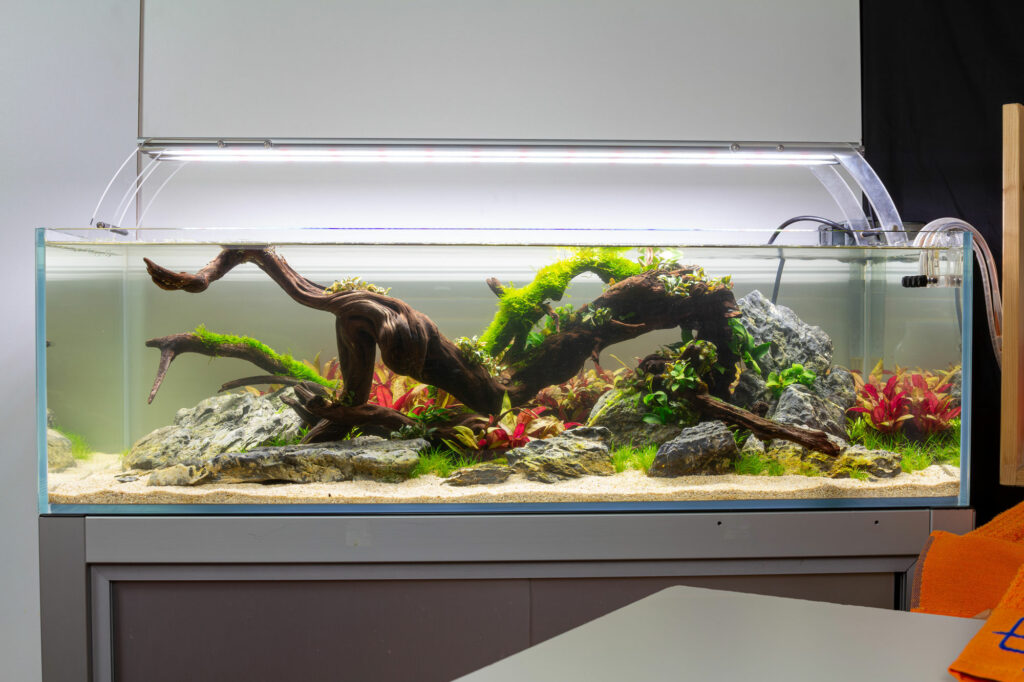
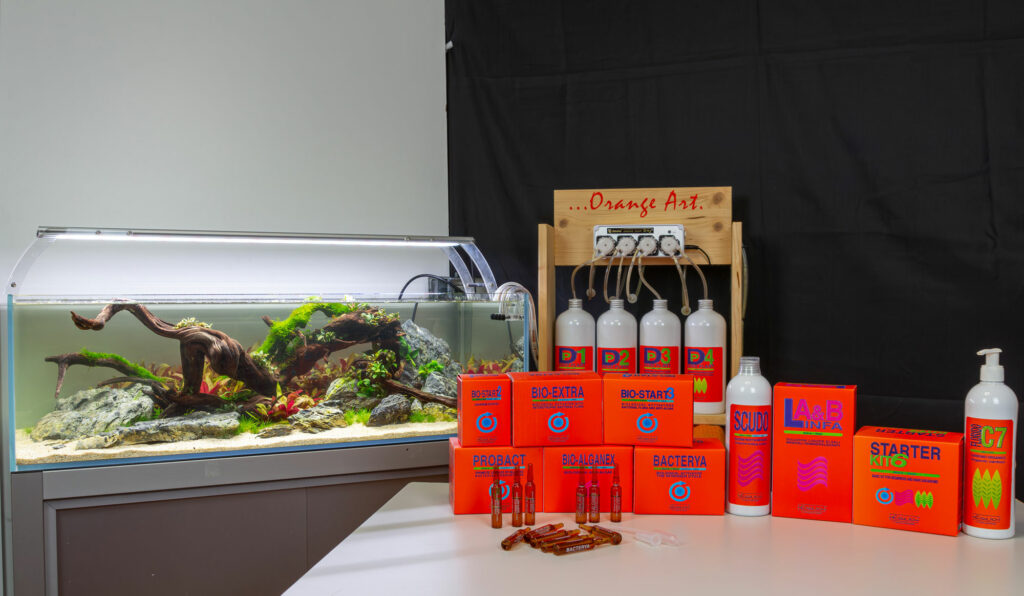
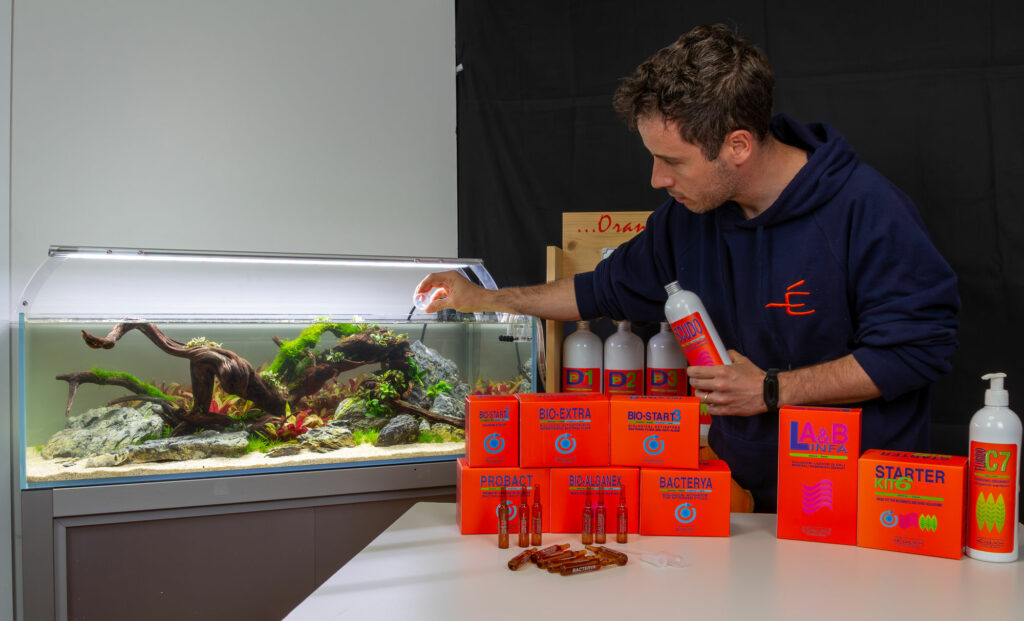
Below are photos of the tank as soon as it was filled, and the moment when I inserted the products for activating and remineralising the water:
Part 4 coming soon, Roberto Bielli

Roberto Bielli – DOSO PLANT BALLING METHODE – Part Two

Second part of Roberto’s new project with E’quo, to build a magnificent aquarium, using the balling method for fresh water.

TANK PLANTING

Products Used:
SCUDO, FLORIDO TABS, BIO-EXTRA


Plants Used:

– Alternanthera Reineckii ‘Mini’
– Bucephalandra Spp. ‘Red’
– Cryptocoryne Parva
– Eleocharis Spp. ‘Minima’
– Leptodictyum Riparium (Stringy Moss)
– Anubias Barteri varietà nana ‘Mini’
– Anubias Barteri varietà nana ‘Mini Mini’
– Vesicularia Dubyana

Planting procedure:

– Preparation of water treated by reverse osmosis with SCUDO;
– Inserting some FLORIDO TABS in the substrate, in the area where we will plant Alternanthera Reineckii ‘Mini’;
– Washing the Cups under running water, to remove residues of the nutrient gel Division of the portions to be planted;
– Planting all plants with roots in the substrate with tongs;
– Tying the mosses with cotton thread on the wood;
– Anchoring of epiphytic plants between the coves of the wood and rocks;
– Misting with water treated by reverse osmosis and SCUDO.

Conduction and Dry Start Methode:

– For about twenty days, the tank will be kept in Dry Start Methode, to allow the plants to take root and the mosses to anchor well in the wood;
– I will constantly spray the tank at least 3 times a day with water treated with reverse osmosis, SCUDO and BIO-EXTRA (activator of heterotrophic bacterial flora) to promote biological activation of the biosystem;
– Photoperiod with 8 hours of light from day one, and CO2 supply with fan;
– Covering the tank with kitchen foil to maintain a high level of humidity.

Objective:

With this project I would like to try to recreate an autumnal setting, the sensation one should have when looking at the aquarium should be that of feeling immersed in an autumn undergrowth.

See you soon with the third part, Roberto Bielli

Hardscape and Wabiscaping techniques, by Roberto Bielli, 4th part

Continue reading “Hardscape and Wabiscaping techniques, by Roberto Bielli, 4th part”

Nano Scape by Enrico Fortuna, 4th part

In the article in question we will discuss the products used and together we will see the evolution of the 3 tanks over time. Their management and related management techniques.

This will be an article focused on images and products. Let’s start immediately with a series of photos that show us the progress over time.

Scape 1


This tub, defined for beginners, represents the first piece of the project. Composed exclusively of plants that are not very demanding in terms of fertilization, light…

The plants included are:
Eleocharis Parvula,
Bucephalandra Sp.,
o Riccardia Chaemedrifolia,
Weeping Moss.

The fauna included:
Celestichthys Erythromicron (ex. Microrasbora Erythromicron)
o Caridina Japonica,
o Otocinclus Affinis.

Water values:
pH = 6,8/7
GH = 6°
KH = 4°
NO2 = 0 ppm
NO3 = 0 ppm
PO4 = 0,5 ppm
Fe = 0 ppm (not measurable)
CO2 = 20 ppm
Temperature 20/22 °C

Used materials:
o
Bio-start2
o
Bio-soil
o
Linfa A
o
Florido ABC
o
Vigor
o
Terranera Extrafine

Fertilization protocol:

Hardscape

 Start up


30 days


50 days


Scape 2

The second aquarium of the project represents a more advanced type of tank than the first as it is made up of a predominantly rocky layout, with the presence of load, a meadow formed by Hemianthus Callitrichoides, and red plants of the Rotala genus, in the rear portion.

The plants included are:
Eleocharis Parvula,
Hemianthus Callitrichoides,
o Rotala Sp.

The fauna included:
Paracheirodon innesi

Water values:
pH = 7
GH = 16°
KH = 5°
NO2 = 0 ppm
NO3 = 10 ppm
PO4 = 1 ppm
Fe = 1 ppm
CO2 = 18/20 ppm
Temperature 20/24 °C

Used materials:
o
Bio-start2
o
Bio-soil
o
Linfa A
o
Florido ABC
o
Vigor
o
Terranera Extrafine

Fertilization protocol:

Hardscape

Planting


Start up


30 days


50 days

90 days


Scape 3


The last piece of the project, a dwarf Scape with the predominance of a large Main Stone, placed in the center, with two other stones around it to complete the Hardscape, finally surrounded by small roots.

The plants included are:
(fast growing, but simple to manage)
Eleocharis Parvula,
o Hygrophila Pinnatifida Weeping Moss,
o Micranthemum Micranthemoides;
Riccardia Chaemedrifolia.

In this small tank I wanted to test the effectiveness of fertilizers associated with their safety on fauna. For the occasion I inserted about twenty small Neocaridina Crystal Black, two Otocinclus Affinis and a small group of Microrasbora Erythromicron.

The fertilizers did not cause any problems for the Caridine or the fish, although the plants grew quickly and well.

Water values:
pH = 7
GH = 10°
KH = 4°
NO2 = 0 ppm
NO3 = 5 ppm
PO4 = 0,5 ppm
Fe = 0,5 ppm
CO2 = 18/20 ppm
Temperature 25 °C

Used materials:
o
Bio-start2
o
Bio-soil
o
Linfa A
o
Florido ABC
o
Vigor
o
Terranera Extrafine

Fertilization protocol:

Hardscape

Planting

Start up

30 days


50 days

90 days


Note

The use of Bio-soil, Vigor and Terranera Extrafine guarantees optimal growth of the root system, reinforced by the bacterial component, which breaks down, remineralises and makes the elements present at the bottom of the root system bio-available.

The dosages of fertilizers were calibrated and then adapted, over the weeks based on the vegetative response, increasing or decreasing them. The water (prepared according to the methods seen in the previous article) is changed every week at a rate of approximately 20%.

Glass and furnishing materials are cleaned as needed. Pruning is carried out approximately every 10, 15 days, based on plant growth.

The chemical parameters of the water are measured once a week (in the first month), then every month or whenever the need arises. However, I recommend carrying them out at least every 2 weeks;

Enrico Fortuna

Hardscape and Wabiscaping techniques, by Roberto Bielli, 3rd part

Continue reading “Hardscape and Wabiscaping techniques, by Roberto Bielli, 3rd part”

Hardscape and Wabiscaping techniques, by Roberto Bielli, 2nd part

Continue reading “Hardscape and Wabiscaping techniques, by Roberto Bielli, 2nd part”

Nano Scape by Enrico Fortuna, 2nd part

Continue reading “Nano Scape by Enrico Fortuna, 2nd part”